
Home, Search, Index, Links, Pathology, Molecules, Syndromes,
Muscle, NMJ, Nerve, Spinal, Ataxia, Antibody & Biopsy, Patient Info
|
Home, Search, Index, Links, Pathology, Molecules, Syndromes, Muscle, NMJ, Nerve, Spinal, Ataxia, Antibody & Biopsy, Patient Info |
 Channels & disorders Anions ATPase Calcium Cation Chloride Concepts Cyclic nucleotide-gated Gap junctions Long QT Syndromes Magnesium Mitochondrial solute carriers Na+, K+, Cl- Co-transporters Piezo Potassium HCN KCN K+/H+ ATPase Proton-gated Sodium Na+/H+ exchangers Non-voltage-gated Voltage-gated Toxins Transient receptor potential Channel binding proteins Transmitters/Receptors Acetylcholine ATP Capsaicin Catecholamines Dopamine Glutamine Glycine Purines Diagrams |
CHANNEL TYPES: General 9
|
|
Classes Voltage gated (CLCN; CLCK) Intracellular (CLIC) Calcium activated (CLCA) Anion channels (SLC4) Na-K-Cl Cotransporters Principles Disorders |

 :
Kidney
& 4
:
Volume sensitive
: Nuclear
: Xq28
: Plasma membrane; Interacts with Erk7
: Brain, Heart, Placenta, Skeletal muscle
: Heart; Skeletal muscle
:
Intestinal basal crypt epithelium & goblet cells
: Lung & trachea
:
? Does not function as a channel protein
:
Kidney
& 4
:
Volume sensitive
: Nuclear
: Xq28
: Plasma membrane; Interacts with Erk7
: Brain, Heart, Placenta, Skeletal muscle
: Heart; Skeletal muscle
:
Intestinal basal crypt epithelium & goblet cells
: Lung & trachea
:
? Does not function as a channel protein

|
; Chromosome 5q31.1-q33.1; Dominant
)
)
)
)
:
CLC-7
|
Figure Principles: Na+ channels Exchangers Non-voltage-gated Voltage-gated Subunits SCNA; SCNB; SCNN NAH exchangers: SLC9; SLC other Cation (CNG) Na+ channel disorders |
: Nav1.1
32: Nav1.2
: Nav1.3
: Nav1.4
: Nav1.5
: S1103Y mutation, especially homozygosity
: Nav2.x
: Nav1.6
: Myoclonus in arms
: Nav1.7
: Nav1.8
: Nav1.9
: Dominant
:
Pseudohypoaldosteronism I
:
Pseudohypoaldosteronism (Liddle syndrome)
:
Pseudohypoaldosteronism (Liddle syndrome)
)
:
Insensitive to amiloride
: Stomach
:
Brain, Testis, Spleen, Skeletal muscle
: Gastrointestinal
: Sperm specific
:
Glucose/Galactose malabsorption
: Renal
:
Congenital hypothyroidism
:
Familial erythermalgia
& SCNN1B
:
Congenital hypothyroidism
:
Glucose/galactose malabsorption
& β
)
& μ
)
|
Ca++ channel disorders Ca++ channel: Figures Types Voltage-gated Ca++ channels Classes L; N; P; Q; R; T Principles CACN: A; B; G Other Ligand gated (ATP2) Intracellular activation (RYR; IP3) Ca++ sensors Cation (CNG-gated) Other (NAADP; EDG1) |
:
Skeletal muscle;
L-type DHP receptor
: Heart, Fibroblasts, Lung, Smooth muscle
: Brain (Striatum; Substantia nigra), Cochlea; Pancreas, Neuroendocrine
: Retina
: Brain, Motor neurons (Presynaptic terminals), Kidney
: CNS, PNS
: Brain, Muscle (NMJ)
: Brain
: Kidney; Liver; D hair mechanoceptors
: Brain
: Skeletal muscle, Brain, Heart, Spleen
: Brain, Heart, Lung, aorta
: Many tissues
: Brain, Kidney
:
Skeletal muscle, Neuronal, Lung
:
Neuronal
,
γ-2
subunits
:
Cardiac
& PP2A
44
:
Brain & Muscle
:
Associated with secretory granules
: Retina specific subunit
deficiency
)
containing L-type channels ((+/-)Bay K 8644)
& IVB
1
:
Ducky mouse; Ataxia & Slow wave seizures|
Figure K+ channel disorders Principles Structure Functions Voltage gated Inwardly rectifying KCa Subunits |
Types HCN KCN A; B; C; D; E; F; G; H; J; K; M; N; Q; S; T; V KCTD H+/K+-ATPase Plasmolipin SUR |
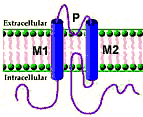
|
:
Atypical with 6 transmembrane domains
;
Leiurotoxin 1
;
(+)-tubocurarine; UCL-1684
|
KCN types A; B; C; D; E; F; G; H; J; K; M; N; Q; S; T; V |
31
: Leu298Phe mutation; Dominant
:
Brain; Delayed rectifier
:
β1 subunit (Kv-β-1.1)
:
β2 subunit (Kv-β-1.2)
:
Brain
:
Brain, Skeletal muscle
:
Brain
:
:
Large transcript abundant in heart; Smaller one brain specific
27
(Kir1.1):
(Kir2.1)
(Kir3.1)
(Kir2.3)
(Kir3.4)
(Kir3.2)
(Kir6.1)
(Kir3.3)
(Kir1.2; Kir4.1)
(Kir6.2)
: Unregulated insulin secretion
(Kir2.2)
(Kir7.1)
(Kir2.4)
(Kir4.2)
(Kir5.1)
(Kir2.6)
:
Related to cyclic nucleotide-gated cation channels
:
36
signaling pathway
34
:
Many tissues; Eye ganglion cells & inner nuclear layer
(TWIK-1-like)
(TASK3 protein)
 36
:
Ca++ activated; Large conductance
:
Ca++ activated; Large conductance
(SK1)
(SK2)
(SK3)
(SK4)
36
:
Ca++ activated; Large conductance
:
Ca++ activated; Large conductance
(SK1)
(SK2)
(SK3)
(SK4)
|
|
: Pancreatic islets
: Binds to Kv2.1 & Kv4.2; Alters gating energetics
: Binds to Kv2.1; Blocks K+ currents
and Cl- channel (CLC-Kb)
:
Recessive
:
Dominant
:
Chromosome 4q25-q27; ? gene
:
Recessive
: KCNQ1
:
& KCNQ3
: KCNB1
: KCNT1
& Opsoclonus-Myoclonus: KCTD7
: KCNK4
: KCNK9
: KCNN3
;
Chromosome 9q22; Recessive
;
Chromosome 16q13; Recessive
;
Chromosome 11q23; Dominant
37; Chromosome 16q13; Recessive
: Erythrocyte band 3 protein
: Anion exchanger; ? Choroid plexus, GI & Other
:
Na Bicarbonate cotransporter; Renal; Renal tubular acidosis, glaucoma, cataracts, & band keratopathy
:
Na Bicarbonate cotransporter; Pancreas
:
Na Bicarbonate cotransporter; Retina
:
Salla syndrome (Sialic acid storage)
42
:
Olfactory
)
:
Retina with CNGA1
:
Achromatopsia 3 (Pingelapese blindness
)
:
β polypeptide
:
α polypeptide
:
α polypeptide
: Na+ channel
:
(SPASIC)
(hINaC (human intestine Na+ channel))
: Renal
: Renal
:
Early erythroid maturation
:
&
AE1 (SLC4A1) anion exchanger
|
Group 1 TRPC (canonical) TRPV (vanilloid) TRPM (melastatin) TRPA (ankyrin) TRPN (NOMPC-like) Group 2 TRPP (polycystin) TRPML (mucolipin) |
26
:
Expression widespread; Activated by diacylglycerol (DAG) & Intracellular Ca++ depletion:
Vomeronasal organ, Testes, Heart, Brain, Sperm; ? Pseudogene in humans
:
Brain, Placenta, Heart, Muscle; Activated by DAG & InsP3R; Inward & Outward rectifying
:
Brain cortex, Testes, Placenta, Adrenal, Endothelium; Receptor operated:
Brain; Receptor operated
:
Lung, Brain, Muscle (Smooth), Heart, Eye; Activated by DAG; Inward & Outward rectifying
:
Vanilloid receptor-related (VRL-1)
(VRL-3)
39
: Most severe
:
ECAC-1
:
ECAC-2
:
Polycystic kidney disease, Dominant

|
| Gap junction |
& Dominant (DFNA3)
21
:
Formation of functional gap junctions in neocortex interneurons
: Skin
: Gated by cytoplasmic acidification or halothane
: Testis
: Multiple organs
:
In oligodendrocytes; Mouse knockout ? CNS myelin abnormalities
: Deafness, Autosomal Recessive (DFNB29): Primary Hypomagnesemia
| Ion channel | Binding protein | Mechanism & Effect |
|---|---|---|
|
K+ channel, Voltage-gated Shaker type NMDA receptor NR2 subunit |
Chapsyns*: PSD-95
;
SAP97 ;
Chapsyn-110
;
Sap102 ;
Dlg
|
Binding via PDZ** domains 1st & 2nd on PSD-95 Post-synaptic densities in CNS |
|
NMDA receptor
NR1 subunit |
α-actinin
|
Actin binding protein Concentrated in dendritic spines |
| Glycine receptor (GlyR) |
Gephyrin
|
Binds to β intracellular loop of GlyR & tubulin |
| AChR: Nicotinic | Rapsyn/43K | Neuromuscular junction localization |
|
Na+ channel Voltage-gated |
Ankyrin G
|
Node of Ranvier localization |
|
AMPA receptor GluR2 subunit
|
Glutamate receptor interacting protein 1 (GRIP1)
|
Binding via PDZ domain Couples receptor to cytoskeletal & signaling molecules |
|
Glutamate receptor Metabotropic Subunits: mGluR1a
& mGluR5
|
Homer1
|
Binding via PDZ-like domain Expression ↑ by synaptic activity Cerebellar development |
;
Chromosome 20q13.2-q13.3; Dominant
;
Chromosome 1p21; Dominant
:
Bladder enlargement; Dilated, unresponsive pupils
;
Chromosome 5q33-q35; Dominant or Recessive
;
Chromosome 4q31.3; Sporadic or Recessive
16
;
Chromosome 11p15.5; Dominant or Recessive
: Recessive
: Dominant
;
Chromosome 7q35-q36; Dominant-negative
; Chromosome 3p21-p24; Dominant
)
; Chromosome 4q25-q26; Dominant
; Chromosome 21q22.1-q22.2; Dominant
; Chromosome 21q22.1; Dominant
; Chromosome 17q23.1-q24.2; Dominant
;
Chromosome 12p13.3; Dominant
;
Chromosome 3q25; Dominant
;
Chromosome 11q23; Dominant
;
Chromosome 7q21-q22; Dominant
;
Chromosome 20q11.2; Dominant
Congenital syndrome
;
Chromosome 11q24; Dominant
syndrome;
Chromosome 14q32.11; Dominant
syndrome;
Chromosome 2p21; Dominant
syndrome;
Chromosome 19q13.32; Dominant or de novo
; Chromosome 21q22.1-q22.2; Recessive
; Chromosome 11p15.5; Recessive
; Chromosome 3q26.33; Recessive; Chromosome 6q22.31; Recessive;
Chromosome 7q36.1; Dominant
;
Chromosome 11p15.5-p15.4; Dominant
;
Chromosome 17q24.3; Dominant
;
Chromosome 2q35; Dominant
 What are the properties of the mutations in the chloride channel gene (CLC1)
that determine whether a syndrome is inherited in a dominant or recessive pattern?
What are the properties of the mutations in the sodium channel gene (SCN4A)
that determine whether a syndrome presents with myotonia, paramyotonia, or weakness?
What are the properties of the mutations in the chloride channel gene (CLC1)
that determine whether a syndrome is inherited in a dominant or recessive pattern?
What are the properties of the mutations in the sodium channel gene (SCN4A)
that determine whether a syndrome presents with myotonia, paramyotonia, or weakness? |
Marine toxins Ciguatoxin Conotoxins Palytoxin (Clupeotoxism) Tetrodotoxin Shell fish Saxitoxin: Paralytic Domoic acid: Encephalopathic Brevetoxins: Neurotoxic Diarrheic Other Lidocaine Potassium channel |
|
Epidemiology Toxicity Clinical Laboratory |
|
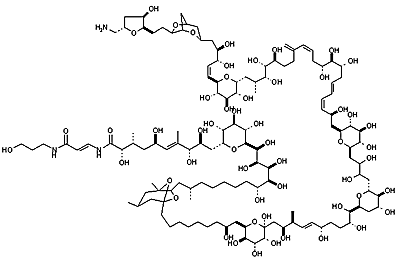 From NCI Palytoxin
|
,
GIA
,
GII
, MI,
SI
,
SIA
,
SII
, EI
binds to α-γ subunit interface
binds to α-δ subunit interface >
α-γ
binds to α7
,
MVIIA
,
SVIA
, MVIID
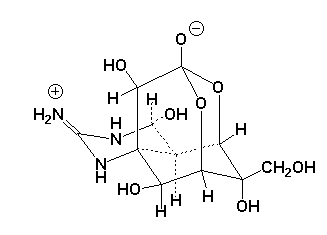
|
| Tetrodotoxin |
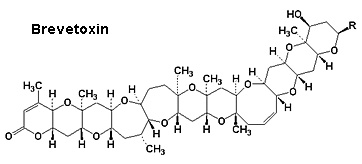 From FDA |