Front
,
Search
,
Index
,
Links
,
Pathology
,
Molecules
,
Syndromes
,
Muscle
,
NMJ
,
Nerve
,
Spinal
,
Ataxia
,
Antibody & Biopsy
,
Patient Info
MYASTHENIC SYNDROMES: VARIANTS
MYASTHENIC SYNDROMES: DRUG-INDUCED
CLINICAL PATTERNS
Rapid Onset
Development of prominent myasthenic signs within days
Anti-AChR antibodies absent
Rapid disappearance after drug withdrawal
Probably related to unmasking of pre-existing disorder of neuromuscular transmission
Exacerbation of Myasthenia Gravis
Develops after days to weeks
Clinical patterns
Subclinical myasthenia gravis becomes manifest after drug treatment
Post-operative respiratory depression
Myasthenia gravis becomes chronically present
Known myasthenia becomes more severe
Anti-AChR antibodies often present
Drugs with clear effects on myasthenia:
Antibiotics
Neomycin
Streptomycin
Gentamicin
Colisitins
Telithromycin: Exacerbation within 2 hours of administration
6
? Kanamycin
Anti-rheumatic
Prednisone (High dose): Onset days after administration
Chloroquine
NMJ blockers
Curare
Non-depolarizing (Vecuronium)
Botulinum toxin
Other:
Quinidine
Procainamide
Procaine
Magnesium
β-blockers
? Phenytoin
None of these drugs is absolutely contra-indicated in myasthenia
If important to treat a serious disorder
Monitor myasthenia carefully: Especially respiration & swallowing
If new or more severe myasthenic signs develop:
Treat & consider stopping the medication if necessary
Other drugs with anecdotal reports of MG exacerbation
Antibiotics: Tobramycin; Amikacin; Polymyxin B; Tetracyclines; Lincomycin;
Clindamycin; Erythromycin; Ampicillin;
? Fluoroquinolones (Norfloxacin, Ofloxacin, Pefloxacin
®
Reduced MEPP amplitude)
Other: Verapamil; Trimethaphan; Trimethadione;
Lithium
; Chlorpromazine; Trihexyphenidyl;
D,L-carnitine; Bretylium; Emetine; Lactate; Methoxyflurane;
Contrast agents; Citrate anticoagulant; Trasylol; Gabapentin
Drug-induced MG: Slow Onset
New immune-mediated myasthenia gravis induced by drug treatment
Onset: weeks to months after drug treatment
Slow & possibly incomplete recovery after drug cessation
Anti-AChR antibodies may be present
Specific drugs
Penicillamine
Associated with HLA-DR1
Clinical: Similar to other autimmune MG
Remits on withdrawal of drug
May also produce
myositis
&
neuromyotonia
Other drugs: Diphenylhydantoin; Chloroquine; Quinidine; Trimethadone;
Procainamide
OCULAR MYASTHENIA GRAVIS
3
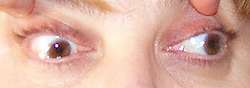
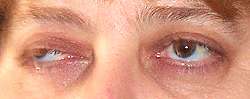
MG: Limitation of adduction
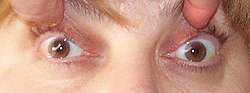
MG: Ptosis
Clinical
Onset: Diplopia & Ptosis
Weakness
EOM paresis
Symptomatic diplopia
Distribution: Usually asymmetric & bilateral
Fluctuates
Worse in evening
Differs from thyroid eye disease: Worse in morning
EOM often dysconjugate
Saccades: Slower at end of eye movement
Ptosis
Unilateral or Bilateral
Worse side may vary from day to day
Orbicularis oculi
Pupils: Normal
Fatigue
Levator palpebrae
Lid twitch
With down-gaze to up-gaze
Lid elevates excessively & then droops again
Ptosis with sustained up-gaze
Extraocular muscles
Saccadic slowing
Rapid small saccades
Gaze evoked nystagmus after sustained gaze
Quiver eye movements
Orbicularis oculi: Afternoon ectropion
Prognosis of ocular MG
Disease course: Variable
May represent initial stage of MG that evolves into generalized weakness (40% to 60%), or
Can remain localized to extraocular muscles
MG that remains selectively ocular for 2 years rarely becomes generalized thereafter
Generalized MG
may present with selective ocular changes
Frequency: 50% of generalized MG patients
94% progress to develop generalized signs over 1st 2 to 3 years
Treatment
Immunosuppression or Corticosteroids: Best improvement
Anti-AChE medications: Little long term benefit in most patients
Thymic hyperplasia
: Occurs but less common than in generalized MG
Laboratory
Repetitive nerve stimulation
: Facial nerve most sensitive
Single fiber EMG
: May be abnormal in up to 95% of MG if facial muscles are included in studies
Anti-AChR antibodies
Present in 50% to 70%
Lower titers than with generalized MG
Antibodies bind best to adult AChRs with
e
subunit
Acetylcholinesterase inhibitors
Outcome assessment: Quantitative measurement or eye movements
False positives: LEMS; Botulism; Guillain-Barré; ALS; Intracranial neoplasms
AChRs at NMJs: Reduced in both ocular & systemic muscles in most patients
Work-up: Other
Myasthenia gravis:
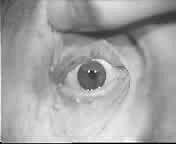
Eye movements
.avi movie from D Zee MD
Rule out
Intracranial lesion: Head MRI
Thyroid ophthalmopathy: Orbit MRI
Rule out
thymic
pathology: Chest CT
Thyroid
function testing
Treatment
Prednisone
is most effective
Start at 5 mg/day
Increase daily dose by 5 mg each week
Stop increasing: Symptoms begin to improve, or 30 mg q.d.
Taper slowly over months when symptoms have resolved
Maintenance: Low doses of 10 to 15 mg q.o.d.; Usually few side effects
Anticholinesterase
medications: Often not effectve
Mechanical: Lid crutches; Taping eyeglasses
External links
Ophthalmology CPC
Eye movement disorders
MYASTHENIA GRAVIS, ACQUIRED: OTHER FOCAL SYNDROMES
Bulbar
Onset: Dysarthria; Dysphagia
Weakness
Orbicularis oris
Tongue
Masseter: Jaw opening & closing
Pharynx
Other: Neck, anterior or
posterior
Differential diagnosis:
Bulbar dysfunction
Course: May remain localized or progress to more general weakness over time
Treatments, initial: To produce rapid improvement
Anticholinesterase
Plasma exchange
IVIg
Respiratory failure
Onset: May be only initial symptom or sign of disease
Differential diagnosis:
Respiratory failure
Treatments, initial: To produce rapid improvement
Anticholinesterase
Plasma exchange
IVIg
Distal weakness
5
Epidemiology
Frequency of predominantly distal weakness: 3% to 7% of acquired MG
Similar age gender & response to therapy as generized MG
Onset of distal weakness
Onset of disease: 33%
Develops later in disease course: 66%
May develop years after onset of disease
Weakness
Hands: Wrist & finger extensors; Intrinsic hand muscles
Feet: Foot drop; 20%
More proximal muscles also involved: Biceps; Triceps
Usually bilateral
Occasionally asymmetric
Laboratory
Distal
repetitive nerve stimulation
at 3 Hz
Frequently shows decrement (87%)
More commonly positive than with generalized MG (55%)
Anti-AChR antibodies: Commonly present (80% to 100%)
Thymoma: Not described
MYASTHENIA GRAVIS: ACQUIRED SLOW CHANNEL SYNDROME
Weakness: Variable
Ocular: Extraocular muscle (EOM) weakness; Ptosis
Bulbar: Dysphagia
Limb: May be focal in legs or arms
Repetitive contraction: Fatigue after transient increase
Electrophysiology
Decrement at 1 to 5 HZ
Increment: Mild (50%) at 10 to 50 Hz
Repetitive compound muscle action potentials (CMAPs)
MEPPs: Low amplitude with Longer time constant of decay
AChR channel properties altered: Reduced Total current; Slow closure
Pathology
Inflammation: CD3+ T-cells > CD20+ B-cells
Higher # of NMJs on single muscle fiber
Normal number of α-bungarotoxin binding sites
Electron microscopy: Simplification of post-synaptic regions without degeneration of junctional folds
Thymus: Hyperplastic
Anti-AChR antibodies
Borderline titers by conventional assay (Mostly fetal AChRs)
Positive in assay of binding to adult AChRs: ? Recognize epitopes on
e
-subunit
Treatment
Response to
anticholinesterase
agents: Variable; Poor to Good
Also see:
Hereditary slow channel syndromes
MYASTHENIA GRAVIS:
ANTI-AChR ANTIBODY
NEGATIVE
Anti-AChR antibodies normally detected by
Binding to AChR
Methodology: Immunoprecipitation assay
Immune MG: Negative anti-AChR antibody testing by routine assay
Clinical associations
Absent anti-AChR Ab more common with
ocular
&
childhood
disease
MG with IgG binding to MuSK
: Also see
MuSK
4
Methodological causes: Anti-AChR antibodies detected by other methods
Rarely (3%) only detected by AChR modulating assay
AChR modulating assay is not specific: Positive results in disorders other than MG
Some patients have plasma antibody (?IgM) that alters AChR function
Reduced AChR opening frequency
Increased AChR phosphorylation
Anti-AChR antibodies may become absent after immunosuppression
Antibody binding to
e
subunit of AChR (adult AChR)
Ocular MG
Acquired slow channel syndrome
Rule out
Congenital/Hereditary MG
Lambert-Eaton MG
Myasthenia Gravis with serum IgG binding to MuSK
4
MuSK protein
Epidemiology
Female predominant (80%)
Onset age
Range: 6 to 68 years
Especially 20 to 60 years
Younger than anti-AChR antibody positive patients
Frequency
Present in many (30% to 70%) European anti-AChR antibody negative MG patients
Less common in Japan, Norway & Phillipines
More common in Afro-Americans
Female > Male
Clinical associations
Clinical syndrome
General: Similar to generalized MG with anti-AChR antibodies
Onset: Often acute or subacute
Prominent signs
Face weakness (100%)
Bulbar
: Dysarthria (Nasal speach) 100%
Ocular (90%)
Respiratory
: Crises common
Limb weakness: 30%; Less often at onset
Associated MG may be more difficult to treat: Anti-AChE drugs not effective
Variant syndromes
Posterior neck
& Respiratory weakness with preserved EOM
Oculobulbar + Facial
Tongue atrophy
Often resistant to immunotherapy
Electrodiagnostic: RNS may be normal; SFEMG abnormal in face
Permanent weakness
Common
Face & Tongue: With atrophy
Pharyngeal
Not present with
Ocular MG: Pure
Thymus pathology: Thymoma; Thymic hyperplasia
Anti-AChR antibodies
Course: Episodic exacerbations common
Electrophysiology
RNS: Decrement
In some patients (57%)
May be present in some muscles but not others
Less frequent than in other Ab- MG patients
SFEMG
Abnormal in selective muscles with weakness
More severe than degree of myopathic changes
More severe involvement in facial muscles
EMG: Irritable myopathy in some patients
Serum factors
IgG vs MuSK properties
Class
Mostly IgG4
Some IgG1
Properties
Often directed against amino terminal (extracellular, IgG-like) sequences of MuSK
May induce some AChR aggregation on myotubes
High affinity binding
Other serum factors
Non-IgG: Reduces AChR function
Muscle pathology
NMJ pathology
Less post-synaptic damage
Less widening of synaptic cleft
Number of AChRs at NMJs: May be normal
Varied fiber size
Scattered necrosis
Tongue MRI: Atrophy; Increased signal
Treatment
Often only partial benefit: Residual symptoms common
Exacerbations reported during immunosuppression
Plasma exchange: Effective for crises
IVIg: Effective in some patients
Corticosteroids
Cyclosporine
? Azathioprine
Anti-AChE medications (Pyridostigmine)
Little or no benefit in majority
Useful in some patients
Thymectomy: No benefit
Also see:
Congenital MG with MuSK deficiency
MYASTHENIA GRAVIS: Animals
1
,
2
Acquired MG
Epidemiology
Relative risk
Higher: After 2 to 3 years of age
Lower: Sexually intact male dogs
Breeds with predisposition
Cats
: Abyssinians (and related Somalis)
Dogs
: Akitas; German shorthaired pointers; Chihuahuas
Rottweilers; Doberman Pinschers; Dalmations; Newfoundland
Clinical features
Weakness
Generalized (~ 50% to 60%)
Focal: Face; Posterior neck; Eyes; Trunk
Fatigue: Ptosis of eyelids, ears, head
Shortened stride
Refusal to move
Dysphagia & Regurgitation: Megaesophagus
Extraocular muscle weakness
Course
Dogs: Often monophasic with remission within 1 to 2 years
Cats: More frequent chronic course
Laboratory
Mediastinal mass (3% to 5%)
Thymoma
Common in cats with MG (80%)
Uncommon in dogs (2%): More in older dogs
Megaesophagus
Serum: Anti-AChR antibodies
Treatment
Megaesophagus
Small feedings while erect: Elevate food & water
Gastrostomy
Thymoma: Thymectomy
Weakness
Pyridostigmine bromide (Syrup): Start with low dose; May be poorly tolerated
Dogs: 0.5 to 3.0 mg/kg po bid or tid
Cats: 0.5 mg/kg q 12 h po
Neostigmine: Dogs: 0.5 mg/kg po bid or tid; 0.04 mg/kg q6h IM
Prednisone
Dogs: 0.5 mg/kg/day increasing in 0.5 mg/kg/day increments every 4 days to 2.0 mg/kg/day
Cats: 1.5 to 2 mg/kg q12h po
Congenital MG
Breeds
Jack Russel terriers
Smooth haired fox terriers
Springer spaniels
Gammel Dansk honsehunds
Samoyeds
Return to
Neuromuscular home page
Return to
Myasthenic syndromes
References
1. J Am Vet Med Assoc 2000;216:55-57
2. J Am Vet Med Assoc 1997;211:1428-1431
3. Semin Neurol 2000;20:7-20
4. Nature Medicine 2001;7:365-368, Lab Invest 2002;82:1139–1146, Neurology 2002;59:1672–1673
Brain 2003;126: Online June, Neurology 2003;60:1978–1980
5. Acta Neurol Scand 2003;108:209–210, Neurology 1999;52:632-634
6.
Neurology 2006;67:2256–2258
12/27/2006