
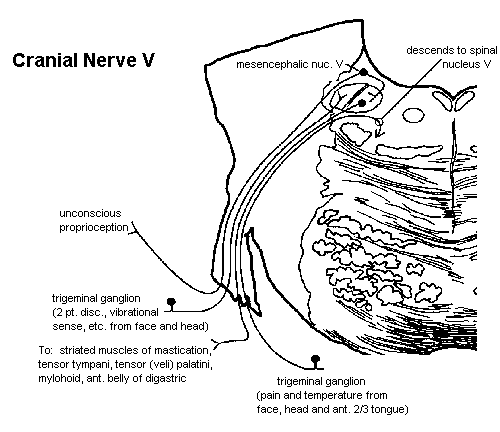
Cranial Nerve V
|
From Anonymous
Facial Onset Sensory & Motor Neuronopathy (FOSMN) 1
- Epidemiology
- > 100 sporadic patients: Australia, Japan & France
- 65% to 70% male
- Genetics
2
- Inheritance: Usually sporadic
- TDP-43 mutations: Some patients; A315T, G386E, N390D, N390S
- Clinical
- Onset
- Age: Range 7 to 78 years; Mean 54 years
- Face: Paresthesias & Numbness (Trigeminal distribution)
- Sensory loss
- Course
- Slow progression
- Early: Face; Bilateral; May be asymmetric
- Progresses to: Scalp, Neck, Upper trunk & Upper limbs; Legs in 10%
- Small fiber sensations: Pin reduced > Temperature
- Taste: Reduced
- Corneal reflex: Reduced
- Vibration & Proprioception: Normal
- Course
- Weakness: Later in disease course
- Other muscle features
- Cramps
- Fasciculations
- Wasting: Masseter; Temporalis; Neck
- Reflexes
- Tendon: Reduced or Absent
- Plantar: Flexor
- Upper motor neuron signs: 28%
- Cognitive or behavioral dysfunction: May be common
- Bladder & Bowel: Normal
- Progression
- Slow to Moderate over years
- Anatomy: Rostral to Caudal
- Immunomodulating agents: Little or No response
- 1 patient with upper motor neuron signs & rapid progression
- Survival: 14 months to 46 years; Mean 8 years
- Cause of death: Often respiratory
- Differential diagnosis: Tangier disease; Gelsolin amyloid
- Onset
- Laboratory
- Serum IgG binding to Sulfatide: High in 50%
- Serum CK: Mildly high; Mean 297; Range 100 to 900
- CSF: Normal
- MRI: Atrophy of mid-cervical spinal cord
- Electrophysiology: Sensory-Motor Neuronopathy
- SNAPs: Reduced amplitudes in arms more than legs
- F-wave latencies: Prolonged
- EMG: Denervation, Chronic partial
- Distributiontion: Trunk, proximal & distal
- Motor units: Large
- Fasciculations
- Blink & Trigeminal reflexes: Abnormal (94%)
- Blink: Delayed R2 response or Complete absence
- No cortical hyperexcitability
- Pathology
- Cranial nerve atrophy: V & IX-XII
- Motor
- Motor neuron loss: Facial & Hypoglossal nucleus; Cervical anterior horns
- Anterior roots: Atrophic
- Brain: TDP-43 glial inclusions
- Sensory nuclei & ganglia: Neuron loss
- Peripheral nerve: Axon loss
- Muscle: Denervation
- Skin biopsy: Trigeminal
- Myelinated axons: Reduced
- Unmyelinated epidermal axons: Normal
Cranial Dysinnervation Disorder, Congenital, with Absent Corneal reflex & Developmental delay (CCDDRD)

● Neurogenin 1 (NEUROG1)
; Chromosome 5q31.1; Recessive
- Epidemiology: 3 families
- Genetics
- Mutations: Missense, Stop, Duplication
- NEUROG1 protein
- Basic helix-loop-helix (bHLH) protein
- Transcription factor
- Astrocyte differentiation
- Role in cranial sensory ganglia development
- Formation of Cranial nerves V & VIII
- Clinical
- Onset: Congenital or Early infant
- Cornea: Opacities; Reflex reduced
- Deafness: Sensorineural; Cranial nerve 8 dysgenesis
- Face
- Expressionless
- Dysmorphic
- Oromotor dysfunction
- Asymmetry
- Eyebrows: High arched
- Palpebral fissures: Elongated
- Plagiocephaly
- Developmental delay
- Laboratory
- Brain imaging: Cochlear & CN8 hypoplasia
- NCV: Axon loss
- Agenesis: Cochlea; Cranial Nerve V (1 patient)
Return to Neuromuscular Home Page
Return to Cranial nerves
References
1. Brain 2006;129:3384–3390, Muscle Nerve 2010; Online November, Neurology 2012;79:73–79, Neurol Sci 2016;37:1905-1909, Neurology: Clinical Practice 2020, Clin Neurophysiol 2022 May 10
2. Neurol Genet 2024;10:e200160
6/5/2024